User-side AI safety. On your device. Under your control.
User Interface

Dashboard
The operational surface. Default view is plain language: "Assessed the AI's response: noted quietly", "Noticed something (self-harm concern) - added a note", "Staying quiet - already mentioned this recently." An engineer-view toggle shows the full technical log. Evaluations counted, interventions recorded, governor actions tracked, all from the last 24 hours. The Amnesia Net status shows when memory was last decayed. The audit log timestamps every Council convening, every intervention, and every decision that produced no visible response. Nothing happens silently that is not recorded locally.

Fossils: the text-free memory
The Guardian remembers that concerns occurred, never what was said. Each fossil records a category, a severity score, the response level the system chose, which model was active, stance adjudication (assert/mention, affirmed/negated where applicable), and negation evidence for recovery-suppressed catches. Fossils are stored encrypted on your device and automatically forgotten over time by the Amnesia Net.

Fossil detail: inside a single observation
Open any fossil and the full Council deliberation is there: every evaluator's verdict, its rationale, the resolved category and severity, session metadata, and the alpha-index that determined the response level. Semantic fossils carry markers: -slm, -slm-cooled, -slm-concur, -slm-negated, -assert/-mention, -negated/-affirmed, -replay. At the bottom, in the product's own words: "No conversation content is stored. The Guardian does not know what you or the AI said - only that this pattern shape was observed."
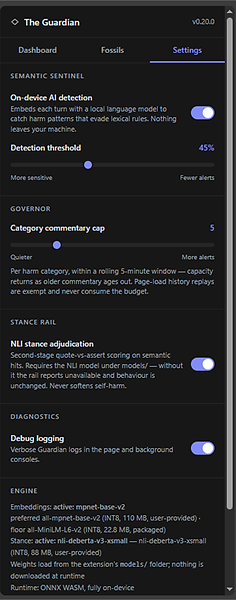
Settings and Engine Status
Every operational dial is in the person's hands. The semantic threshold, the commentary budget (per-category rate window), the stance rail, debug logging - all configurable, all taking effect on the next decision with no reload. The Engine box at the bottom is the provenance record: which embedding tier is active, which stance model loaded, their sizes and quantisation, the ONNX WASM runtime, the 87 anchor phrases across 8 harm categories, and the licenses folder. Every claim the site makes about on-device models, this box confirms in the running extension.
